top of page

Discover the Latest in Biomedical Research Innovation
Search


Guide to ChIP-seq Library Preparation: Protocols, Optimization, and Troubleshooting
Stop losing valuable ChIP data during library prep! Our Ultimate Guide to ChIP-seq Library Preparation covers everything from "Standard" protocols to "Ultra-Low Input" strategies. Learn how to eliminate adapter dimers, choose between NEBNext vs. MicroPlex, and master the art of ChIPmentation. Perfect for researchers struggling with low yields or high duplication rates. Read the full protocol optimization guide now!
3 days ago5 min read


CLYTE to Provide Cornell's Life Science Technology Innovation Fellowship with Soφ 4.0 for MedTech Founders
CLYTE Technologies is transforming life science venture creation through its new partnership with Cornell's Life Science Technology Innovation Fellowship (LSTIF). By providing Soφ 4.0—the first true agentic AI for biomedical research—to incoming cohorts, CLYTE empowers MBA students and PhD researchers to compress grueling regulatory, analytical, and operational workflows into minutes. Learn how MedTech founders are leveraging specialized AI agents to build the future of healt
May 134 min read
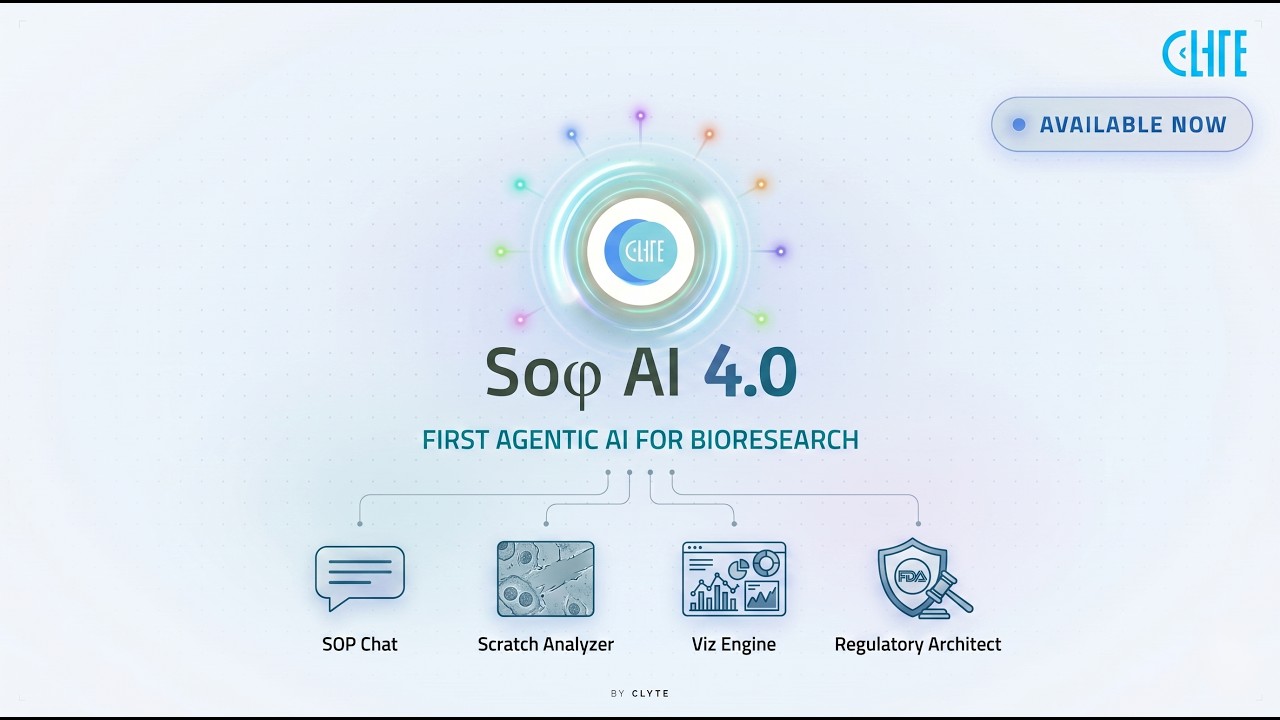
Soφ 4.0 Is Live: The First True Agentic AI Built for Biomedical Research
Meet Soφ 4.0 by CLYTE Technologies: the first AI agent system built exclusively for biomedical research! Moving beyond standard AI, Soφ 4.0 deploys up to 10 specialized agents to handle your workflow. From designing assays and analyzing cell migration 50x faster than ImageJ, to mapping FDA regulatory pathways for MedTech startups, Soφ accelerates your science. Lock in 50% off Sophie Pro before May 30, 2026, and experience the ultimate autonomous lab assistant today!
May 115 min read


EdU vs. BrdU Proliferation Assays: Guide to Choosing the Right Protocol
Stop struggling with harsh acid washes and destroyed tissue morphology. This guide compares the classic BrdU proliferation assay against the modern EdU click-chemistry method. Discover why EdU is the superior choice for speed, sensitivity, and multiplexing, and learn how to perform dual-pulse labeling to unlock detailed cell cycle kinetics.
May 46 min read


The Ultimate Guide to Resazurin Assays: AlamarBlue vs. PrestoBlue Protocols & Optimization
Switch to Resazurin (AlamarBlue/PrestoBlue) for accurate, live-cell metabolic monitoring. Our Ultimate Guide covers the differences between the reagents, a master "Add-and-Read" protocol, and the math you need to calculate viability accurately. Perfect for cancer research and cytotoxicity screening. Read the full protocol here.
May 14 min read


How to Do Outlier Detection: Grubbs’ Test vs. ROUT Method
Are outliers ruining your datasets? In biomedical research, distinguishing between biological variability and technical error is critical. This guide compares the traditional Grubbs’ Test against the modern ROUT method, explaining why the ROUT method's False Discovery Rate (FDR) approach is superior for detecting multiple outliers in pre-clinical data. Learn the exact protocols for GraphPad Prism and R to clean your data scientifically and avoid P-hacking.
Apr 296 min read


t-SNE vs. UMAP for Single-Cell Data: The Guide to Dimensionality Reduction
Struggling to choose between t-SNE and UMAP for your single-cell data? UMAP has become the industry standard due to its speed and global structure preservation, but t-SNE still offers unique advantages for local granularity. This guide breaks down the mathematical differences, "Chari & Pachter" controversy, and proper parameter tuning to help you create scientifically accurate visualizations.
Apr 275 min read


Logistic Regression for Binary Outcomes in Pre-Clinical Research
Stop using linear regression for binary data! If your pre-clinical research involves "Yes/No" outcomes—like mouse survival, tumor presence, or assay viability—you need Binary Logistic Regression. This guide bridges the gap between complex math and bench science, explaining exactly how to run, validate, and interpret logistic models. Learn how to handle Odds Ratios (OR), avoid "Perfect Separation" errors in small cohorts, and satisfy the statistical standards of top-tier biome
Apr 245 min read
bottom of page