

The Ultimate Guide to Resazurin Assays: AlamarBlue vs. PrestoBlue Protocols & Optimization
- May 1
- 4 min read
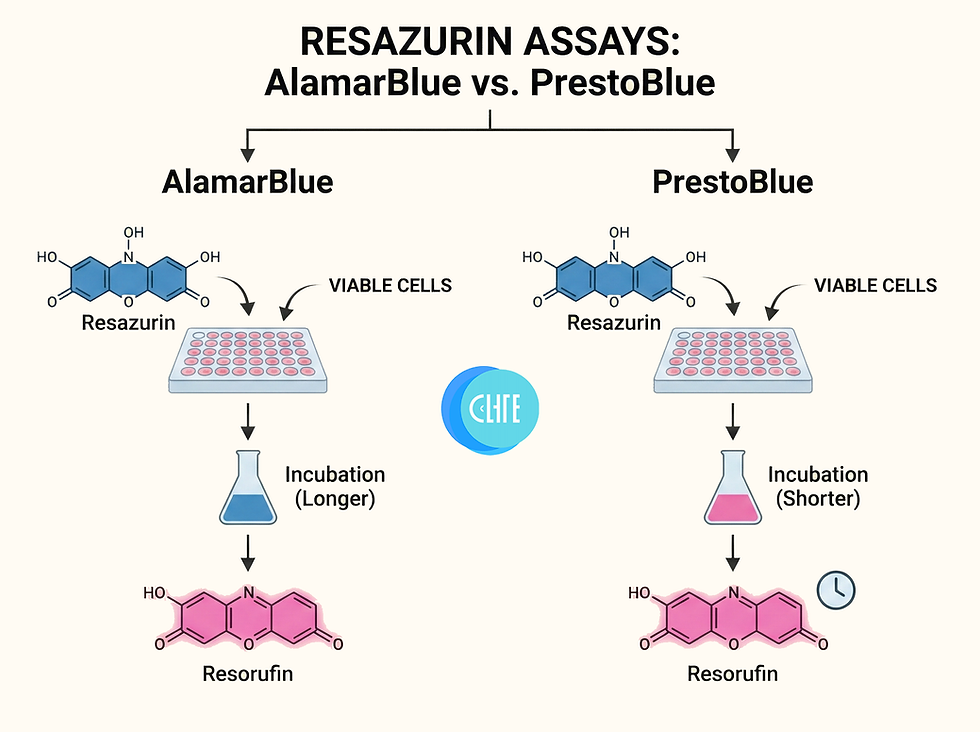
Determining cell health is foundational to life science research. While older methods like MTT force you to kill your cells to read the data, Resazurin-based assays (marketed as AlamarBlue, PrestoBlue, and others) offer a superior alternative: they are non-toxic, water-soluble, and highly sensitive.
This guide consolidates data from peer-reviewed literature to provide the definitive protocol, comparison, and troubleshooting framework for Resazurin assays.
1. The Science: How Resazurin Works
At the core of AlamarBlue and PrestoBlue is the same active ingredient: Resazurin (7-Hydroxy-3H-phenoxazin-3-one 10-oxide).
The Mechanism: Resazurin is a blue, non-fluorescent dye. It permeates the cell membrane and enters the cytoplasm.
The Reaction: Metabolically active cells (specifically the mitochondria and cytosol) maintain a reducing environment (NADH/NADPH/FADH). Enzymes within viable cells reduce Resazurin into Resorufin.
The Readout: Resorufin is pink and highly fluorescent.
Dead Cells: Do not reduce the dye (stays blue).
Live Cells: Turn the dye pink.
Key Advantage: Unlike MTT (which forms insoluble crystals requiring DMSO solubilization), Resorufin is water-soluble and excreted back into the medium. This allows for continuous monitoring and further downstream analysis of the same cells.
2. Comparative Analysis: AlamarBlue vs. PrestoBlue vs. MTT
Based on user discussions from ResearchGate and validation papers (such as those comparing viability in Acanthamoeba and cancer lines), here is how the reagents stack up.
Feature | MTT / XTT | AlamarBlue (Resazurin) | PrestoBlue |
State | Endpoint (Lethal) | Kinetic (Live Cell) | Kinetic (Live Cell) |
Solubility | Insoluble Crystals (Requires DMSO) | Water Soluble | Water Soluble |
Incubation | 3–4 Hours | 1–4 Hours | 10 mins – 2 Hours |
Sensitivity | Moderate | High | Ultra-High |
Cost | Low | Moderate | High |
Protocol | Multi-step (Solubilization req.) | "Add and Read" | "Add and Read" |
Expert Consensus:
While PrestoBlue is marketed as a "faster" reagent with higher sensitivity, published research suggests that for many cell lines (and organisms like Acanthamoeba), AlamarBlue and PrestoBlue are equally useful regarding accuracy. PrestoBlue is essentially a reformulated resazurin solution designed for a quicker reaction rate. Choose PrestoBlue for rapid high-throughput screening; choose AlamarBlue/Generic Resazurin for cost-efficiency.
3. Master Protocol: Resazurin Cell Viability Assay
This protocol synthesizes instructions from ThermoFisher, Bio-Rad, and Sigma manuals. It is applicable for both AlamarBlue and PrestoBlue.
Phase 1: Preparation
Reagent Warm-up: Ensure the reagent is at room temperature before use.
Light Sensitivity: Resazurin is light-sensitive. Keep tubes wrapped in foil and lights dimmed when handling.
Cell Density: Optimization is required. A typical range for a 96-well plate is 5,000 to 50,000 cells/well. You need to remain in the linear range of the assay.
Phase 2: The "Add and Read" Workflow
1. Plate Setup:
Seed cells in a 96-well plate (typically 100 µL total volume of media + cells).
Experimental Wells: Cells + Test Compound.
Positive Control: Cells + Media (untreated).
Negative (Background) Control: Crucial. Media + Reagent (No cells).
Vehicle Control: Cells + Solvent used for drug (e.g., DMSO).
2. Treatment:
Treat cells with your experimental compounds for the desired duration (e.g., 24h, 48h).
3. Reagent Addition:
Add the Resazurin reagent directly to the wells at 10% of the culture volume.
If well contains 100 µL: Add 10 µL of reagent.
Note: There is no need to remove the culture media.
4. Incubation:
Incubate the plate at 37°C / 5% CO₂.
PrestoBlue: Check as early as 10 minutes. Standard is 30–60 mins.
AlamarBlue: Standard is 1–4 hours.
Pro Tip: Because the cells remain alive, you can read the plate at 1 hour, return it to the incubator, and read it again at 3 hours to find the optimal signal window.
5. Measurement:
Measure using a plate reader or spectrophotometer. Fluorescence is recommended for higher sensitivity.
Fluorescence (Preferred):
Excitation: 530–560 nm (Optimum: 560 nm)
Emission: 590 nm
Absorbance (Alternative):
Measure Absorbance at 570 nm (Peak reduction) and 600 nm (Reference/Normalization).
4. Data Analysis & Calculations
Do not rely on raw numbers alone. You must subtract the background.
Fluorescence Calculation (RFU)
△ RFU = RFU_experimental - RFU_background control
%Viability = (△RFU_experimental / △RFU_positive control) x 100
Absorbance Calculation
Absorbance is more complex because both the oxidized (Blue) and reduced (Pink) forms absorb light at overlapping wavelengths.
The simplified formula using 570nm and 600nm:
Calculate the Automated Difference for each well: (OD570 - OD600).
Subtract the Media Only control value from the Cell values.
Normalize to untreated controls.
5. Troubleshooting & Optimization
Common issues identified in manufacturer manuals and research forums.
Issue 1: High Background Signal (Control wells are pink)
Cause: Microbial contamination. Bacteria/Yeast reduce resazurin much faster than mammalian cells.
Solution: Check media under a microscope. Use sterile technique.
Cause: Media interaction. Some media components (like ascorbic acid) can reduce the dye.
Solution: Always run a "Media + Reagent" control (no cells) to subtract this baseline.
Issue 2: Low Signal (Sample wells remain blue)
Cause: Low cell density or low metabolic activity.
Solution: Increase incubation time (up to 24 hours for AlamarBlue is possible, though rare). Increase initial seeding density.
Cause: The cells are actually dead (Assay worked!). Verify visually.
Issue 3: Variable Data / Low Reproducibility
Cause: Edge Effect (Evaporation in outer wells).
Solution: Fill the outer perimeter wells of the 96-well plate with sterile PBS and do not use them for data.
Cause: Pipetting errors. Resazurin is viscous; ensure proper mixing (gentle tapping of the plate).
Can I use this for Flow Cytometry?
Answer: Technically, yes, but proceed with caution. The product (Resorufin) leaks out of cells into the media. For flow cytometry, you are analyzing individual cells. While some protocols exist (using sorting to isolate high-metabolism cells), Resazurin is primarily a bulk-population plate reader assay. For Flow Cytometry viability, fixable viability dyes or Propidium Iodide are superior standards.
References
https://pubmed.ncbi.nlm.nih.gov/25464019/
https://www.researchgate.net/post/Which-is-a-better-assay-among-Alamar-blue-and-MTT
https://pmc.ncbi.nlm.nih.gov/articles/PMC3638707/
https://www.sciencedirect.com/science/article/abs/pii/S1056871914002809
https://www.sciencedirect.com/topics/medicine-and-dentistry/resazurin-assay
https://www.researchgate.net/post/Cell_viability_Assay_Resazurin_or_XTT
https://pmc.ncbi.nlm.nih.gov/articles/PMC11048620/
https://labbox.es/wp-content/uploads/Manuales/MANU_1485.pdf
https://www.bio-rad-antibodies.com/alamarblue-cell-viability-assay-resazurin.html
https://pmc.ncbi.nlm.nih.gov/articles/PMC9554156/
https://www.sciencedirect.com/science/article/pii/S2215016124004758


