

AI in Healthcare: From Science Fiction to Clinical Reality, A Revolution is Underway
Updated: Jan 6
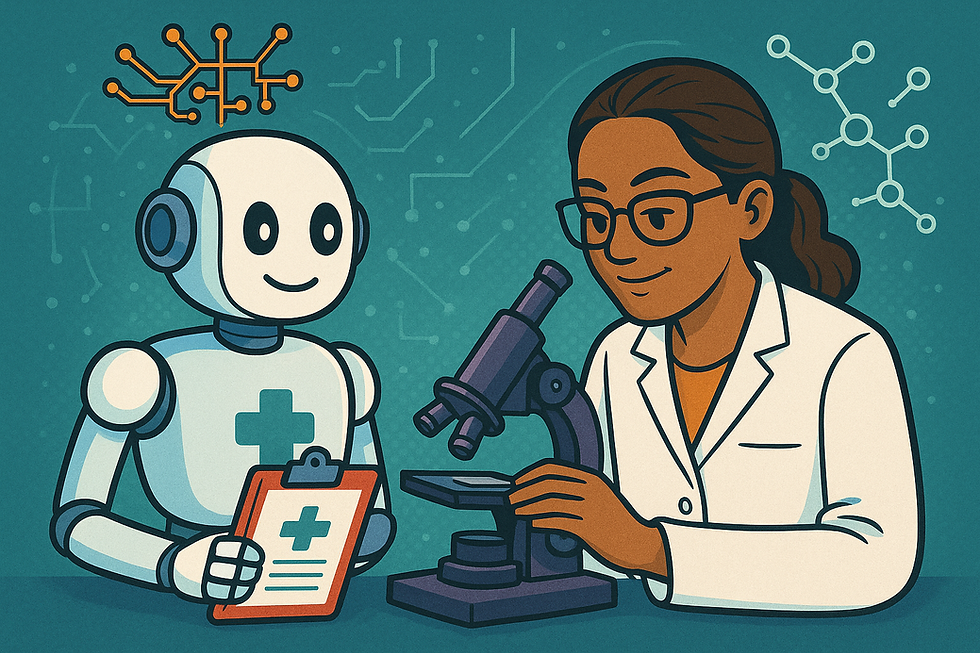
The healthcare landscape is on the cusp of a transformation more profound than any since the discovery of penicillin. Artificial intelligence (AI) is no longer a futuristic concept but a rapidly evolving reality, poised to redefine everything from how we diagnose diseases to the very way we discover new medicines. This technological leap promises a future of more personalized, efficient, and accessible healthcare for all.
For decades, the idea of machines assisting doctors was the stuff of science fiction. Today, AI algorithms are demonstrating capabilities that meet, and in some cases exceed, human expertise. A pivotal 2023 study published in BMC Medical Education underscores the growing integration of AI in medical training, preparing the next generation of clinicians for a tech-driven world. The potential is staggering: the AI in healthcare market, valued at a substantial figure in recent years, is projected to experience exponential growth, signaling a massive shift in the industry.
AI in Healthcare: Transforming Diagnostics and Treatment
One of the most significant impacts of AI in healthcare is in the realm of diagnostics. AI-powered systems can analyze medical images, such as X-rays and MRIs, with a level of accuracy that can pinpoint anomalies invisible to the human eye. This is not about replacing radiologists but augmenting their abilities, allowing for earlier and more precise detection of conditions like cancer and diabetic retinopathy.
Beyond imaging, AI is revolutionizing treatment pathways. By analyzing vast datasets of patient information, from genomic sequences to lifestyle factors, AI can help predict how an individual will respond to a particular therapy. This ushers in the era of "precision medicine," where treatments are not one-size-fits-all but tailored to the unique biological makeup of each patient.
The World Economic Forum highlights several groundbreaking applications already in motion, from AI predicting ambulance needs to identifying early signs of disease long before symptoms manifest. The implications for public health are immense, promising a proactive rather than reactive approach to healthcare.
Fueling the Future of Biomedical Research
The engine of medical progress is research, and here too, AI is acting as a powerful catalyst. The traditional process of drug discovery is notoriously slow and expensive. AI algorithms can analyze complex biological data at an unprecedented speed, identifying potential drug candidates and predicting their efficacy with remarkable accuracy. This acceleration in the research and development pipeline means that life-saving treatments can reach patients faster than ever before.
A critical aspect of biomedical research is the meticulous process of cell culturing, which forms the foundation for developing new therapies. This is where innovative startups are making their mark. Consider CLYTE technology, a burgeoning force in this space. Their AI-driven platforms are designed to automate and optimize the monitoring of cell cultures, a traditionally labor-intensive and error-prone process. By ensuring the health and viability of these crucial biological building blocks, CLYTE is subtly but significantly contributing to the acceleration of biomedical breakthroughs. This kind of technological advancement, though operating in the background, is fundamental to the larger revolution AI is bringing to healthcare.
CLYTE has also introduced Soφ AI (Sophie), a pioneering AI Lab Assistant designed to directly address the critical 'hunt for SOPs' in biomedical research. Far more than a static repository of information, Sophie functions as a dynamic digital collaborator, capable of generating bespoke, interactive protocols tailored to a researcher’s specific cell lines, reagents, and equipment. Beyond planning, the platform’s intelligent troubleshooting engine cross-references millions of data points to instantly diagnose experimental anomalies, while its deep data analysis capabilities can identify subtle patterns and even suggest novel hypotheses. By automating these labor-intensive and error-prone aspects of the scientific workflow, Sophie empowers researchers to shift their focus from routine logistics to groundbreaking discovery, effectively acting as a force multiplier that accelerates the path from bench to bedside.
Future of AI in Healthcare: Challenges and Opportunities
The journey towards full AI integration in healthcare is not without its challenges. Data privacy, algorithmic bias, and the need for robust regulatory frameworks are critical issues that must be addressed. As an article from the National Center for Biotechnology Information points out, ensuring the ethical and responsible use of AI is paramount to building trust among both clinicians and patients.
However, the opportunities far outweigh the hurdles. AI has the potential to alleviate the burden on healthcare systems, reduce costs, and, most importantly, improve patient outcomes. From streamlining administrative tasks to empowering patients with more control over their health data, AI is set to create a more efficient and patient-centric healthcare ecosystem.
The future of medicine will be a collaborative one, where the irreplaceable empathy and expertise of human healthcare professionals are amplified by the analytical power of artificial intelligence. As we stand at this technological dawn, the promise of a healthier future, powered by innovation, is brighter than ever.


