The Best tool for Scratch Assay Analysis: Comparing Soφ, ImageJ, CellProfiler, and More
Updated: Aug 8

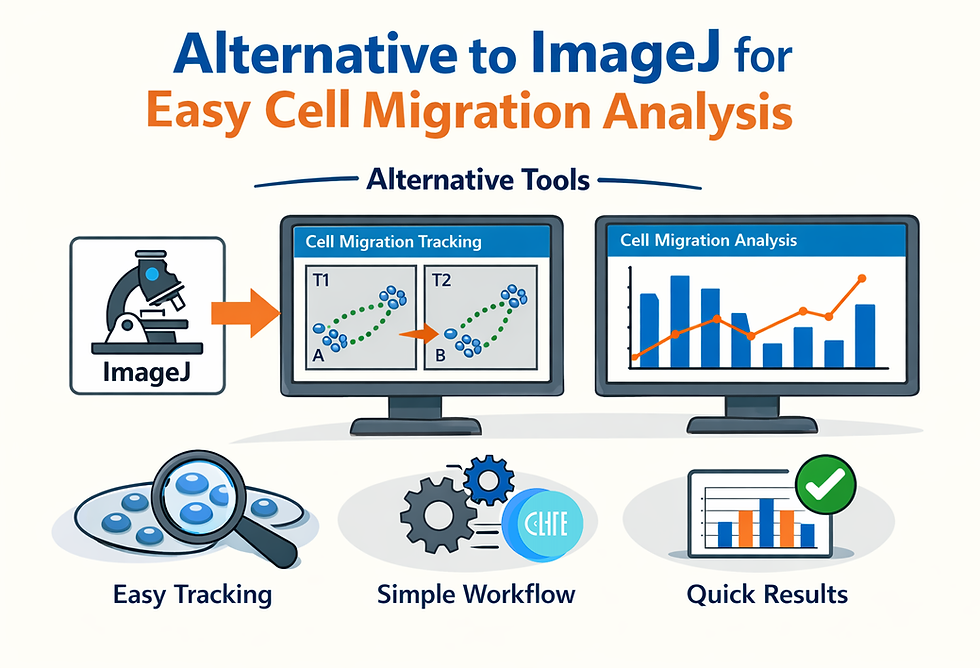
The scratch wound healing assay remains one of the most fundamental methods for studying cell migration in vitro. However, the reliability of this assay depends heavily on how the data is analyzed. With options ranging from general-purpose image processors to specialized AI-driven platforms, choosing the right tool is critical for reproducibility and efficiency.
This analysis evaluates seven distinct image analysis platforms—Soφ Scratch Analyzer, Fiji/ImageJ, CellProfiler, Icy, TrackMate, Ilastik, and CellACDC—assessing their capabilities, workflows, and suitability for specific research questions.
1. The Specialist: Soφ Scratch Analyzer (via Sophie AI Suite)
Best For: High-throughput screening, standardization, and users seeking speed.
Soφ stands out as the only tool in this lineup specifically "purpose-built" for scratch assays. Unlike generalist tools that require parameter tuning, Soφ uses a fixed machine learning algorithm trained on diverse datasets.
Key Advantage: It removes subjective decision-making. By applying fixed parameters and offering an integrated AI assistant (Sophie AI Chat) for statistical interpretation, it ensures highest reproducibility.
Workflow: Streamlined. Users simply upload images, and the system handles detection, measurement, and statistical analysis automatically.
Trade-off: As a specialized web-based tool, it offers less flexibility for "edge case" experiments compared to open scripting platforms.
2. The Generalist: Fiji / ImageJ
Best For: Maximum flexibility, budget-constrained labs, and users comfortable with scripting.
Fiji (ImageJ) remains the industry standard for general image processing. While not designed exclusively for scratch assays, its massive plugin ecosystem (e.g., MRI Wound Healing Tool) makes it adaptable to almost any imaging condition.
Key Advantage: Unmatched control. Users can manually adjust thresholds, preprocess images, and write macros for batch processing.
Workflow: Requires manual or semi-automated input. Reproducibility is heavily dependent on the user's consistency and documentation.
Trade-off: Steeper learning curve and time-intensive analysis without custom automation.
3. The Architect: CellProfiler
Best For: Complex quantitative measurements.
CellProfiler utilizes a modular "pipeline" architecture. It allows researchers to build a specific sequence of analysis steps (modules) that can be saved, shared, and version-controlled.
Key Advantage: Once a pipeline is built, it processes every image exactly the same way, making it excellent for multi-lab collaborations.
Workflow: Front-loaded effort. It requires significant time to design and optimize the pipeline, but once established, it processes batches rapidly.
Trade-off: Not intuitive for beginners; requires an initial time investment to learn pipeline design.
Niche & Advanced Tools
While the top three cover most standard use cases, other platforms offer specific advantages for unique research questions:
Icy: The modern alternative to ImageJ. It excels in 3D/4D visualization and active contour segmentation, making it ideal for invasion assays or time-lapse studies requiring high-end visualization.
TrackMate (Fiji Plugin): The standard for single-cell tracking. It does not measure wound closure area effectively but is unbeatable for analyzing the velocity, directionality, and trajectories of individual cells at the wound edge.
Ilastik: The Machine Learning (ML) trainer. Ideal for heterogeneous or poor-quality images where standard thresholding fails. It allows users to interactively "teach" the software to recognize cells vs. background, though it requires training time.
CellaCDC: The Quality Control specialist. Best for long-term time-lapse studies where cell lineage and division tracking are required. It includes anomaly detection but is less suited for standard wound area measurement.
Comparative Matrix: Workflow & Capabilities
Capability | CellProfiler | Fiji/ImageJ | TrackMate | |
Wound Area Measurement | Excellent | Excellent | Excellent | Not Available |
Setup Time | Minutes | Hours | Hours | Hours |
Reproducibility | Excellent | Excellent | Variable | Good |
Batch Processing | Excellent | Excellent | Good (Macro) | Good |
Analysis Type | Automated | Pipeline | Manual/Macro | Single-Cell Track |
Verdict: Which Tool Should You Choose?
The decision ultimately depends on your primary constraint: Speed, Control, or Granularity.
1. Choose Soφ Scratch Analyzer if...
Priority: Ease, Speed and Standardization.
You need results immediately with minimal training.
You want to eliminate user-to-user variability (e.g., in multi-center studies).
You benefit from AI-assisted interpretation and results writing.
2. Choose Fiji/ImageJ if...
Priority: Total Control.
Your images have unusual staining or lighting that requires manual preprocessing.
You are comfortable with scripting to create your own automation.
You need a completely offline, open-source solution.
3. Choose CellProfiler if...
Priority: Shareable Workflows.
You need to share a strict analysis protocol across different labs.
You are running large experiments and want a "set it and forget it" pipeline.
4. Choose TrackMate or CellaCDC if...
Priority: Individual Cell Behavior.
You care more about how the cells move (velocity, direction) than the total wound closure area.
Best tool for Scratch Assay Analysis
For the standard researcher performing scratch assays to measure wound closure, Soφ Scratch Analyzer currently offers the best reproducibility and high-throughput capability; followed closely by CellProfiler despite the steep learning curve and setup time. Soφ wins on ease of use and AI integration, while CellProfiler wins on customizable modularity. For those needing deep, granular control or single-cell tracking, the open-source powerhouses of Fiji and TrackMate remain indispensable tools in the laboratory.