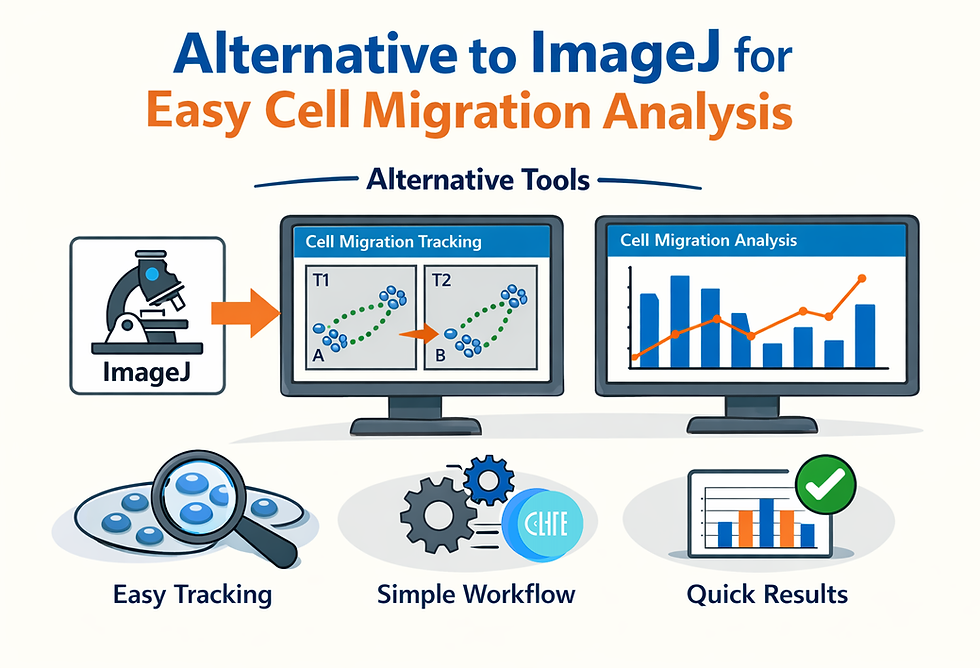
How to use Soφ for Scratch Assay Analysis: The Best Tool for Cell Migration Measurement
- Jan 29
- 3 min read
The traditional scratch assay is a cornerstone of biomedical research, yet for years, the bottleneck has remained constant: manual quantification. As a researcher, staring at dozens of phase-contrast images in ImageJ, manually tracing "wound" edges, and fighting human bias in thresholding is an exhaustive process. This article follows my transition from that manual grind to a streamlined, AI-driven workflow using Soφ AI 3.0 and its new Scratch Analyzer.
The Initial Inquiry: Scratch Assay Analysis
My journey began with a simple inquiry to Sophie Chat. I was looking for a more efficient way to calculate cell migration rates for a large batch of images.
Interactive Guidance: Upon asking about migration analysis, Sophie didn't just provide a wall of text; she provided me with an interactive walk through and recommended her specialized "Scratch Analyzer" feature.
Improvement recommendations: She even recommended using standardized tools like CytCut for my next scratch assay to get the most consistent results!
Faster Processing: The interface was snappy and ready for high-throughput data.
Chat History: Because I had created an account, our consultation was saved, allowing me to refer back to my previous protocols effortlessly.
The Breakthrough: 60 Seconds vs. 4 Hours
The most significant pain point in my workflow was the time spent in ImageJ. I had about 100 images from a recent wound healing assay. Normally, this would have taken days of meticulous clicking.
Using the Soφ Scratch Analyzer
Batch Upload: I clikced on the "Soφ Scratch Analyzer" tool on the top left of the Sophie AI UI and uploaded about 20 of the images simultaneously, just to test it out. The tool can handle up to 200 images in one batch.
Standardized Detection: The AI uses a standardized algorithm to identify gaps and filter out debris. This eliminates the "subjective bias", meaning everyone's images are being analyzed through the same parameters and thus the results will always be reproducible.
Instant Data: In under one minute, the analyzer processed the entire set and provided the gap % analysis data.
Excel Export: The results were exported as an Excel file, ready for the next stage of cell migration analysis.
The Statistical Deep Dive: Full Cell Migration Analysis
Having raw gap percentages is one thing; understanding what they mean for my study is another. I fed the exported data back into Sophie Chat for migration calculation.
Identifying Data Gaps
When I asked about the full migration analysis of my study, Sophie acted as a mentor. She pointed out that to correctly calculate the wound closure and migration within the scope of my study, I need at least 2 time stamps and a control group data.
Following her advice, I analyzed my control and time-series groups through the Scratch Assay Analyzer. Once Sophie had the full dataset, she performed an in-depth breakdown of the migration data, providing a level of analysis that would have taken me days to compile manually.
Final Presentation: From Lab to Conference
With the analysis complete, the next challenge was presenting it. I asked Soφ how I could best showcase these results at an upcoming conference.
Sophie didn't just give advice; she drafted the entire results section of a poster presentation. This included:
A clear narrative of the migration trends.
A breakdown of the statistical significance (p-values) between my experimental and control groups.
A technical description of the analysis, which added a layer of experimental reproducibility and authoritativeness to my work.
Soφ AI has reformed my scratch assay work flow, and could reshape the industry!